

Local traditions link shrine to Gajapati Dibyasingha Dev; deteriorating memorials of former mahants highlight conservation concerns
Dillip Kumar Pattnaik
KHORDHA, OCTOBER 25: The historical legacy and distinctive religious traditions of the Sri Ananta Purushottam Temple at Jagulipatna came into focus during the third Khordha Heritage Walk on Sunday, as participants explored the shrine’s origins, age-old rituals and legends associated with its past. The walk also drew attention to the deteriorating condition of memorials dedicated to former mahants, raising concerns over the need to preserve the temple complex’s lesser-known historical assets.
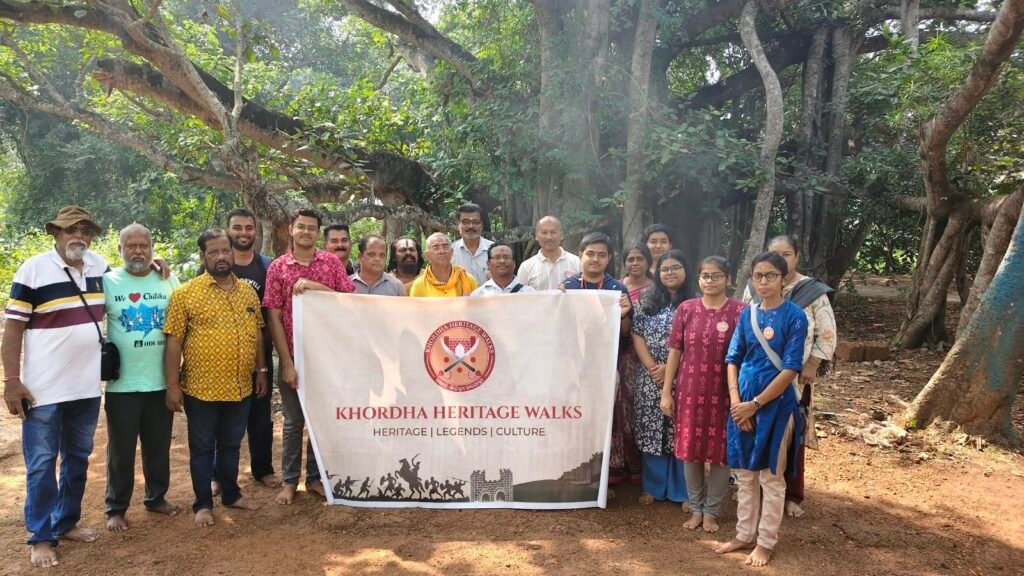
The programme was organised to promote awareness of Khordha district’s rich cultural heritage, encourage the conservation of historical sites and familiarise younger generations with the region’s religious traditions and historical associations.
The heritage walk commenced at Chandi Chua Square at 9 am. Following a welcome by members of the Khordha chapter, the participants offered prayers at the shrine of Maa Chandi before proceeding along the Khordha–Nayagarh road to the Sri Ananta Purushottam Temple at Jagulipatna.
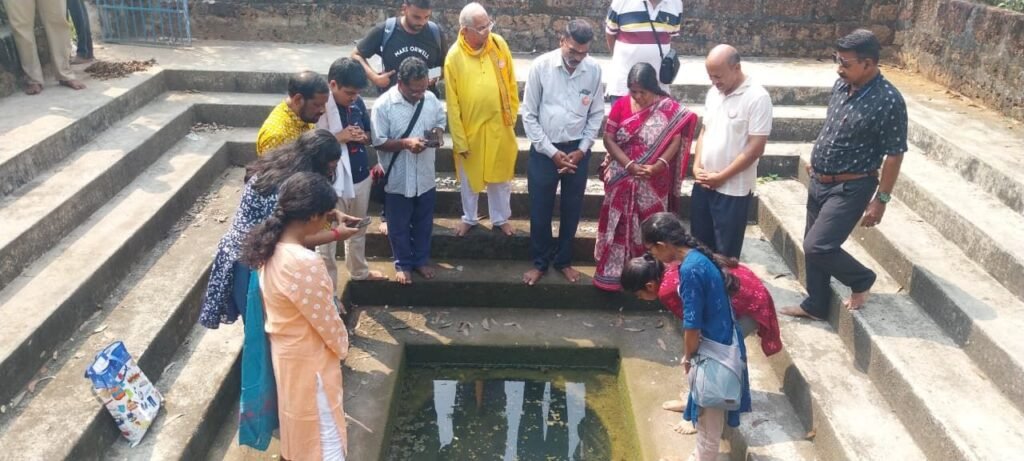
Upon their arrival, they were received by temple servitors Kamal Lochan Das Maharaj and Ganesh Das Maharaj, along with intellectuals Baikunthanath Mohapatra, Minaketan Mohanty and Pradip Kumar Behera, besides local residents.
Senior journalist Prabhat Panigrahi spoke about the temple’s historical background and religious importance, recounting traditions associated with its evolution. Kamal Lochan Das Maharaj explained the daily rituals, traditional forms of worship and annual religious festivals observed at the shrine. Baikunthanath Mohapatra and Minaketan Mohanty also shared their insights into the temple’s cultural legacy and historical significance.
Local traditions link shrine to Gajapati Dibyasingha Dev
The temple’s historical narrative is closely intertwined with local traditions and accounts that point to a possible association with Gajapati Dibyasingha Dev II. According to local lore, the Gajapati was sentenced to transportation to the Andaman Islands during British rule but escaped. He was subsequently apprehended and lodged in Cuttack Jail.
Following his release, he is believed to have taken refuge under Baba Raghubir Das. Local tradition further holds that he later became known as Dayanidhi Das. Although these accounts form part of the shrine’s traditional historical narrative, their historical details would require independent verification.

Another local account concerns the origin of the temple’s presiding deities. According to belief, Lord Jagannath appeared in a dream and directed that sacred timber be brought from Beruhan village for the carving of the idols. Artisans from Puri are said to have sculpted the deities, who were subsequently consecrated by Shautriya Brahmins believed to have arrived from Kerala.
Worship is believed to have initially been conducted in a modest thatched structure before a larger temple was established at the site. Local accounts associate the subsequent growth of Jagulipatna as a religious centre with the development of the shrine and its increasing spiritual importance.
The participants discussed the temple’s distinctive religious identity, centred on Lord Jagannath in his Purushottama form, his elder brother Ananta, identified with Lord Balabhadra, and their sister Subhadra.
Distinctive idols reflect unique religious traditions
The Sri Ananta Purushottam Temple is distinguished by its full-sized idols of Lord Jagannath, Balabhadra and Subhadra. Their iconography and associated worship practices contribute to the shrine’s distinctive religious character.
Balabhadra is depicted holding a plough and a pestle, while Lord Jagannath holds a conch and a discus. These features, together with the temple’s traditional rituals, form an important part of its cultural and spiritual identity.
The temple complex also houses shrines dedicated to Sri Bhairaveswar, Sri Chaitanya, Hanuman and Goddess Lakshmi, besides the samadhi of Mahant Raghubir Das.
During the walk, participants visited the Kalpabata tree, the shrine of Sri Bhairava, the memorials of former mahants, Karunya Kunda, the Jagulei Temple and the Gundicha Mandap. These sites collectively reflect the religious practices, institutional history and cultural traditions associated with the temple.
The visit provided an opportunity to examine the wider heritage of the complex beyond its principal shrine, highlighting the importance of preserving the structures and spaces that have shaped the religious life of the locality over generations.
Rath Yatra revived after a period of suspension
The temple’s annual Rath Yatra was another important subject of discussion during the programme. According to accounts shared by participants, the festival was traditionally celebrated with three chariots before the practice remained suspended for a period.
The Rath Yatra was revived in 1980 and has since continued as a significant religious observance, sustaining the shrine’s association with Lord Jagannath and the region’s traditional festival culture.
Participants stressed the importance of documenting such customs and transmitting their significance to younger generations. They observed that the continuity of traditional festivals plays a vital role in maintaining the cultural identity of historic religious institutions.
Deteriorating memorials raise conservation concerns
The condition of the memorials dedicated to former mahants emerged as a major concern during the heritage walk. Participants expressed apprehension over the apparent lack of adequate maintenance of these structures, which they consider important repositories of the temple’s institutional and religious history.
They called for a systematic assessment of the memorials, regular maintenance and appropriate conservation measures to prevent further deterioration. They also emphasised that heritage protection should not be confined to prominent temples and monuments but must extend to associated memorials, traditional structures and other sites that preserve the history of local religious institutions.
The participants cautioned that neglect could gradually erase important links with the region’s past. They urged the concerned authorities and other stakeholders to take appropriate steps to safeguard the structures while retaining their historical character.
The issue highlighted a broader challenge confronting heritage conservation: while major religious landmarks often attract public attention, smaller memorials and associated historical structures can remain overlooked despite their cultural and institutional significance.
The third Khordha Heritage Walk sought to bring lesser-known historical sites and cultural landmarks into the public domain while encouraging greater community participation in their preservation. The organisers underscored the need to strengthen public awareness of the district’s historical and cultural resources and foster a sense of responsibility towards their conservation.
They also stressed that introducing younger generations to local history, religious traditions and cultural roots was essential to ensuring that the region’s heritage remained protected for posterity.
Preetipallavi Mohapatra coordinated the programme, while other members of the organising team extended their cooperation in making the event successful.

Subha Khabar is now on Whatsapp
Join and get latest news update delivered to you via whatsapp
Join Now